

WRITTEN BY: HARRIE PHILLIPS
PGCertClinEd, BAdVocEd (VocEd&Trng), DipVN (Surgical, ECC), DipBus, DipTAE (Development & Design), TAA
PUBLISHED: 25 June 2026

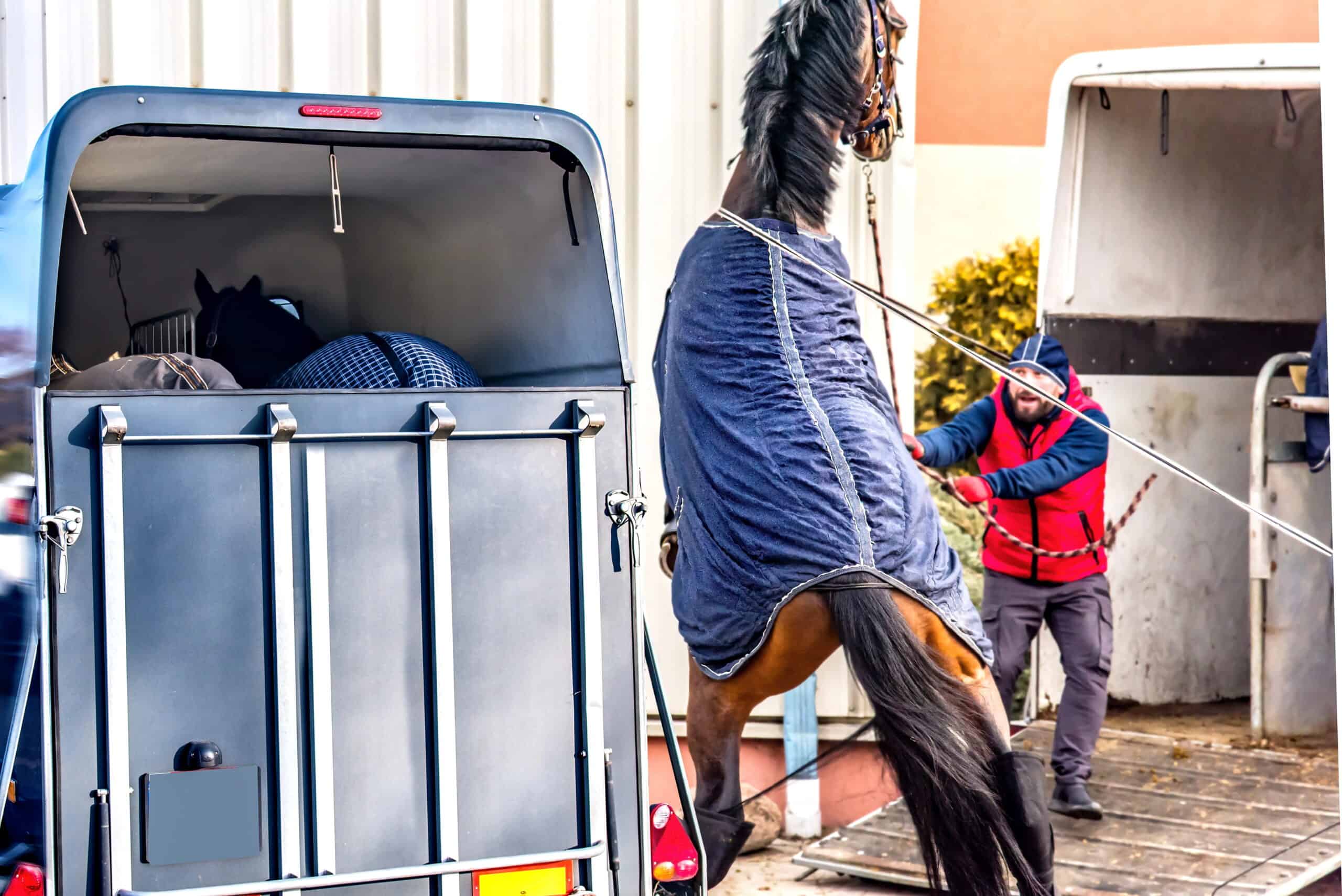
Anyone who has spent a long day at a competition has either been this person or been within thirty metres of it, watching and trying to decide whether to help. The day is winding down. Most of the floats have left, the canteen has shut, the equipment is almost all packed up and the light is going. A horse has been brought up to load and is not having any of it. The handler, who started the morning calm and competent, is now twelve attempts in, increasingly red in the face, increasingly loud, increasingly stressed. The horse swings between being planted, shooting backwards, swinging out sideways, or worse, going up.
What is happening here is not, in most cases, a loading problem. The horse loaded that morning. The horse will load again next week. Fatigue, arousal, previous learning, the environment and the handler’s own state can combine into a stress cascade that changes how the horse responds.
It’s not just about learning new tasks. Understanding why any session, whether that is float loading or any other ordinary task, can come apart this fast, and why pushing harder almost never fixes it, is one of the most useful pieces of equitation science to know.
What is the arousal sweet spot?
Loading at the end of a competition day is, whether anyone wants it to be or not, a learning event. Every minute of it is teaching the horse something about floats, about handlers, about the predictability of pressure, about the world. What the horse learns is strongly influenced by state of the horse’s nervous system at the time. And one of the most annoying things about all of this is that the lessons a stressed horse learns are not the ones we are trying to teach.
In 1908, the psychologists Robert Yerkes and John Dillingham Dodson published a study on dancing mice (yes, really) that became the most-cited piece of psychology research on this question for the next century1. They found that a mild stressor helped the mice learn the correct response faster than a weaker shock did. The original Yerkes-Dodson work suggested that task performance changes with stimulus intensity, but the familiar single “inverted U” is an oversimplification. Later work shows that the relationship between arousal and performance depends on the task, the individual and the type of stressor. Higher or uncontrollable arousal can impair acquisition of complex or novel responses without meaning that learning literally stops.
Modern researchers have refined this picture considerably. The original Yerkes-Dodson “law” has been substantially revised since 1908, and the contemporary view is that there is no single universal curve but rather a family of curves whose shape depends on the complexity of the task being learned2. Simple, well-practised tasks tolerate quite a lot of arousal before learning starts to suffer. Complex, novel, or precision-demanding tasks require much lower arousal to be learned well. Almost like when we turn the radio down in the car to see the house numbers better at night.
This is why a horse can be very forward and switched-on for a warm up ride out across familiar paddocks, where the task is well known and the bar is low, and yet completely fall apart when asked to work on something complex and new in the arena half an hour later. The horse has not become a different horse. The task has changed, and the arousal level that was helpful for the simpler task has become disabling for the harder one.
Melissa Starling, Paul McGreevy and colleagues applied this framework directly to operant conditioning in horses and dogs in 2013, mapping out what they called response landscapes for common training behaviours3. The same behaviour, asked of the same animal, becomes much harder to train when the arousal level is wrong, and the curve is sharper for more complex behaviours. The practical implication is one that good trainers have always understood intuitively. The harder the thing you are asking, the calmer your horse needs to be when you ask it.
A horse who has stopped trying may not have learned the lesson. Sometimes the nervous system has simply stopped expecting that effort will change the outcome.
What does the horse-specific evidence show?
A recent study has shown that stress before a learning task measurably impairs how well horses can actually learn it4. The effect is not subtle. In a study of 41 horses, animals exposed to an uncontrollable stress treatment required more trials to learn a negatively reinforced task than horses given a short session of ridden exercise. The stressed and inactive comparison groups did not differ significantly. The authors concluded that pre-training exercise may facilitate learning, while uncontrollable stress may impair it.
If you have ever started a training session by getting frustrated with a horse on the ground and the whole session has just fallen apart, this is not just bad luck. It’s because the horse you are now trying to teach has, to some measurable degree, lost the cognitive resources required to learn the lesson.
Horses exposed to repeated stress have also been shown to become more sensitive to aversive training stimuli5. The neurobiological mechanism involves cortisol and noradrenaline acting on the amygdala in ways that make fear-based memories particularly strong and particularly resistant to extinction5. Whatever the horse was learning during those twelve attempts at the float is being consolidated by stress hormones in a way that makes it sticky, hard to undo, and likely to resurface the next time the horse sees a float at the end of a long day.
And here’s a little pause for thought. Most riders are taught to warm a horse up for the body. We don’t always think about their mental preparedness for the session. The study provides evidence that a short period of ridden exercise before training may facilitate acquisition of the task compared with stress or inactivity. It supports the practical value of a calm, low-cognitive-demand warm-up, but one study does not establish that warm-up dramatically improves all forms of learning.4. A calm, structured warm-up is not just preparing muscles and joints. It is preparing the cognitive machinery that will be doing the actual learning.
How does the handler affect the horse?
So far the picture is one of stress impairing the horse’s capacity to learn. The science of horse-human interaction over the last two decades has consistently shown, however, that the horse is not the only contributor to stress in the system. The handler is too, and the handler’s stress is something the horse picks up on faster than most riders realise.
The most-cited piece of research in this area is a small study by Linda Keeling and colleagues at the Swedish University of Agricultural Sciences, published in 2009 in The Veterinary Journal6. Horses and their handlers were taken into an arena and walked or ridden along a familiar path four times. On the first three passes, both human and horse heart rates settled as the situation became routine. Before the fourth pass, the humans were told that an assistant standing beside the path was about to open an umbrella as they walked past. The assistant did not actually open the umbrella. Both human and horse heart rates rose significantly on that pass, despite the horses having no way of knowing what the humans had been told.
Because the umbrella was never opened, the rise in the horses’ heart rates was consistent with the horses detecting changes associated with their handlers’ anticipation or tension. The study does not identify exactly which human cues the horses detected.
This finding is sometimes overstated in popular horsemanship, leaning into the claim that horses always mirror their handler’s emotions and that human and equine heart rates routinely synchronise. The reality is more interesting and not quite so poetic. Subsequent work by Jo Hockenhull and colleagues found significant heart-rate correlation in only five of thirty-four horse-human pairings tested7, and a study of high-performance dressage by Mareike von Lewinski’s group found that rider heart rate can rise more sharply than the horse’s during public performance compared with private rehearsal8. The relationship between handler emotional state and horse emotional state is real, well-documented, and bidirectional, but it is not a simple mirroring.
For the purposes of this article, however, the practical implication is what matters. When a session starts to slip and you start to feel frustrated, your horse will register that, and the loop tends to amplify rather than settle on its own. By the time the loading scene at the end of the competition day has reached its twelfth attempt, the handler’s state is one of the loudest signals in the horse’s environment, and it is telling the horse that whatever is going on near this float is, in fact, alarming.
By the time the loading scene at the end of the competition day has reached its twelfth attempt, the handler’s state is one of the loudest signals in the horse’s environment.
Why does pushing through usually fail?
Three things are happening at once.
First, at high or poorly controlled arousal, acquisition of the response the handler wants may become less efficient and the horse may shift towards defensive or previously learned responses. The horse is not cognitively “offline”; it may still be learning powerful associations about the float, the handler and the consequences of its own behaviour. Second, the handler’s own stress is feeding into the horse’s stress, ramping it further rather than allowing it to settle. The natural human response to a horse who is not complying is to apply more pressure or to repeat the cue more firmly, both of which raise the arousal further. Third, high arousal and aversive experiences can strengthen fear and avoidance associations, particularly when the horse has little control over the situation. That makes repeated escalation a welfare and training risk, even though we cannot assume that every specific movement the horse performs is being strongly consolidated.5.
The handler is not just failing to teach the desired response. The handler is actively training a new response, and that response will be particularly hard to undo later because of how stress-mediated learning works.
This is why pushing through is not just unproductive in the moment. It is actively making the next attempt, and the one after that, and the one after that, harder. Each minute spent at the float at the end of the competition day is a minute spent training the horse to associate the float at the end of the competition day with rising stress, escalating handler pressure, and the unpleasant social cluster of bystanders watching. The horse is always learning. And they might not be learning what the handler wants them to learn.
What actually helps?
The most useful skill in horsemanship is recognising the moment when things have started to slip and acting on it then, rather than three or five or twelve attempts later when everything has properly come undone9, 10. This is not simply an accommodating position. It is consistent with learning theory: reducing task difficulty, lowering arousal and reinforcing achievable approximations can help restore a clear contingency without continuing to rehearse conflict.
The components of an effective reset are not complicated. The handler removes the horse from the immediate context for long enough to let everyone’s nervous system come down. This can mean walking the horse around the float in calm circles for a few minutes, or it can mean leading the horse away from the float entirely and asking for some easy, well-known responses on the lead in a quieter spot. The duration depends on how far things had got. Two minutes is sometimes enough.
When the reset has worked and the horse’s arousal has come back into the range where learning is possible, the principle is to ask for a much smaller version of what was being asked before, and to reward generously when the horse offers it10, 11. If the horse was being asked to walk straight onto the ramp, the handler asks for one quiet step toward the float and walks them away again. The next attempt asks for two steps. The next, three. This is basic shaping: reduce the criterion to an achievable step, reinforce it clearly, and build again gradually. Doing so can lower conflict and help the horse regain a predictable sense of control over the task.
The person handling the horse also needs the same care. If you are tense or upset, the horse may detect changes in posture, movement, muscle tension, breathing, rein or lead-rope use and other cues, so regulating your own behaviour can be part of resetting the interaction. The two-minute walk around the float is for both of you, and there is no point doing it for the horse alone. Breathing, dropping the shoulders, unclenching the hands, and letting the heart rate settle are part of the training intervention, not ancillary to it.
Ending on something easy is not weakness. It is applying well established learning consolidation principles. There is good practical reason to avoid ending a session by repeatedly rehearsing fear or conflict. Finishing after an achievable, low-arousal response can leave the horse with a clearer recent history of success, but there is no simple equine rule that the final behaviour of a session is always the one remembered most strongly. Ending the loading session with a horse who has voluntarily walked one step toward the float and been generously rewarded is a substantially better outcome than ending it with a horse who finally got loaded after twenty-five minutes of escalating pressure, even if the latter feels more like success in the moment.
The moment when things start to slip is not the moment to push harder. It is the moment to do something else entirely.
Back to the float
The same scene at the end of the competition day, with one decision made differently, looks like this. The handler asks for the load. The horse plants on the third attempt. The handler notices, lets the rope go slack, walks the horse a calm hundred metres away from the float, breathes for a minute, asks for a few easy lead-rein responses (a back-up, a few steps to the side), then walks the horse back toward the float without asking them to load. They stand near it for a moment. The handler asks for one quiet step in its direction, rewards it, walks away again. They come back. They ask for two steps. The bystanders, sensing that the moment has passed, drift back toward their own floats. The horse is loaded and out the gate within fifteen minutes of the reset, calmly enough that there will be no flow-on effect on next month’s loading.
This is what training looks like when we work with the horse rather than against it. It is also what nearly every experienced trainer does instinctively, often without being able to articulate why, and what the equitation science literature now allows everyone else to do deliberately rather than by feel12.
The horse in this scene walks the whole way to the venue and back, which is a far bigger physical job than most riders realise. That is the subject of the next article, on transport welfare. And for the wider case for working with the horse rather than asserting authority over them, see why you do not need to be the leader of your horse.
References
- Yerkes, R.M., & Dodson, J.D. (1908). The relation of strength of stimulus to rapidity of habit-formation. Journal of Comparative Neurology and Psychology, 18, 459–482.
- Diamond, D.M., Campbell, A.M., Park, C.R., Halonen, J., & Zoladz, P.R. (2007). The temporal dynamics model of emotional memory processing: a synthesis on the neurobiological basis of stress-induced amnesia, flashbulb and traumatic memories, and the Yerkes-Dodson law. Neural Plasticity, 2007, Article 60803. https://doi.org/10.1155/2007/60803
- Starling, M.J., Branson, N., Cody, D., & McGreevy, P.D. (2013). Conceptualising the impact of arousal and affective state on training outcomes of operant conditioning. Animals, 3(2), 300–317. https://doi.org/10.3390/ani3020300
- Henshall, C., Randle, H., Francis, N., & Freire, R. (2022). The effect of stress and exercise on the learning performance of horses. Scientific Reports, 12, 1918. https://doi.org/10.1038/s41598-021-03582-4
- Henshall, C., Randle, H., Francis, N., & Freire, R. (2022). Habit formation and the effect of repeated stress exposures on cognitive flexibility learning in horses. Animals, 12(20), 2818. https://doi.org/10.3390/ani12202818
- Keeling, L.J., Jonare, L., & Lanneborn, L. (2009). Investigating horse-human interactions: the effect of a nervous human. The Veterinary Journal, 181(1), 70–71. https://doi.org/10.1016/j.tvjl.2008.09.013
- Hockenhull, J., Young, T.J., Redgate, S.E., & Birke, L. (2015). Exploring synchronicity in the heart rates of familiar and unfamiliar pairs of horses and humans undertaking an in-hand task. Anthrozöos, 28(3), 501–511. https://doi.org/10.1080/08927936.2015.1052281
- von Lewinski, M., Biau, S., Erber, R., Ille, N., Aurich, J., Faure, J.-M., Möstl, E., & Aurich, C. (2013). Cortisol release, heart rate and heart rate variability in the horse and its rider: different responses to training and performance. The Veterinary Journal, 197(2), 229–232. https://doi.org/10.1016/j.tvjl.2012.12.025
- Mendl, M. (1999). Performing under pressure: stress and cognitive function. Applied Animal Behaviour Science, 65(3), 221–244. https://doi.org/10.1016/S0168-1591(99)00088-X
- McLean, A.N., & Christensen, J.W. (2017). The application of learning theory in horse training. Applied Animal Behaviour Science, 190, 18–27. https://doi.org/10.1016/j.applanim.2017.02.020
- McGreevy, P., Christensen, J.W., König von Borstel, U., & McLean, A.N. (2018). Equitation Science (2nd ed.). Wiley-Blackwell. ISBN 978-1-119-24141-6. View at Wiley
- International Society for Equitation Science. ISES Training Principles. Available at: www.equitationscience.com/ises-training-principles
Every due care has been taken to ensure the information herein is based on sources Veterinary Nurse Solutions believes to be reliable, but is not guaranteed by us and does not purport to be complete or error-free. As such, we do not warrant, endorse or guarantee the completeness, accuracy, and integrity of the information. You must evaluate, and bear all risks associated with, the use of any information provided hereunder, including any reliance on the accuracy, completeness, safety or usefulness of such information. As part of our quality control of information contained within this document, it has been peer-reviewed by qualified animal care professionals.
Veterinary Nurse Solutions acknowledges that there is more than one way to carry out many of the tasks described within this website, and techniques omitted are not necessarily incorrect.