

WRITTEN BY: HARRIE PHILLIPS
PGCertClinEd, BAdVocEd (VocEd&Trng), DipVN (Surgical, ECC), DipBus, DipTAE (Development & Design), TAA
PUBLISHED: 2 July 2026

What the science says about the hidden work of float travel, why recovery matters, and how to set your horse up for the trip
You load up, close the ramp, and settle into the driver’s seat (or, if you’re lucky, the passenger seat and get a snooze in) for the hour-long trip to a clinic or competition. You spend that hour sitting down. Your horse spends it standing up. And standing up in a moving vehicle is not the same as standing still. Every time you accelerate, brake, change lanes or take a roundabout, your horse has to brace, shift and rebalance to stay on their feet.
We all know this, but have you ever stopped to think about the effect on your horse? By the time you arrive, you have been resting, but your horse has pretty much just “walked” to your destination. They’ve been doing continuous postural work to balance. One small physiological study found that 30-minute transport periods in five Shetland ponies produced heart-rate and energy-expenditure increases similar to walking.
It’s so easy for us to not even really think about short journeys, and the effect on our horses. But it has real consequences for the horse, and we should think about how we manage our horses on either side of a journey. The research on transport and horses really tells us that we need to slow that sequence down, and to think more carefully about what we ask of a horse in the minutes and hours after the ramp comes down.

Is the float a workout your horse cannot opt out of?
The clearest direct evidence comes from a study that measured both heart rate and energy expenditure in Shetland ponies at rest, while walking, and during transport. The increases during transport were significant, and they were comparable to the values recorded while the animals were walking1. In other words, a horse standing in a moving float is expending energy at roughly the rate of a horse out for a walk, except they never get to choose where to put their feet, or to stop and rest a while.
It would be reasonable to assume that an elevated heart rate during travel simply reflects psychological stress. Some of it does, but a substantial part of it is physical. Researchers used electromyography to record activity in the splenius muscles, which sit along the neck and do anti-gravitational, postural work, and correlated that muscle activity with heart rate during transport. Activity in those postural muscles and heart rate rose together2. So when a travelling horse’s heart rate climbs, part of that figure reflects genuine muscular work, the effort of holding the body steady against the constant, unpredictable movement of the vehicle.
A study comparing twelve hours of confinement with twelve hours of transport found that balance-related behaviours increased markedly during transport, and that horses travelling rear-facing and in wider bays showed fewer of them3. The same study reported something that should give every owner pause: loss of balance during the journey was associated with the severity of gastric ulceration afterwards, and with elevated muscle enzymes3. Those enzymes, chiefly creatine kinase, spill from muscle cells into the bloodstream when muscle has been worked hard or strained.
So a horse that struggles to balance in the float isn’t simply a bad traveller. They are working extra hard to stay on their feet, and paying for that effort physically.
Transport can increase muscular work and some studies report changes in muscle enzymes, especially during longer journeys or where balance is challenged. So mounting up straight after unloading asks those same muscles to carry us and perform, and to perform well if we are at a competition, when they have only just finished a “workout” of their own. Picture going to the gym, running into your best friend who has just wrapped up their leg day, and talking them into joining your session too. They will do it, because they’re a good friend, but they are not going to lift the way they did in their own workout. Our horses are in exactly that position when we ride them off the float.
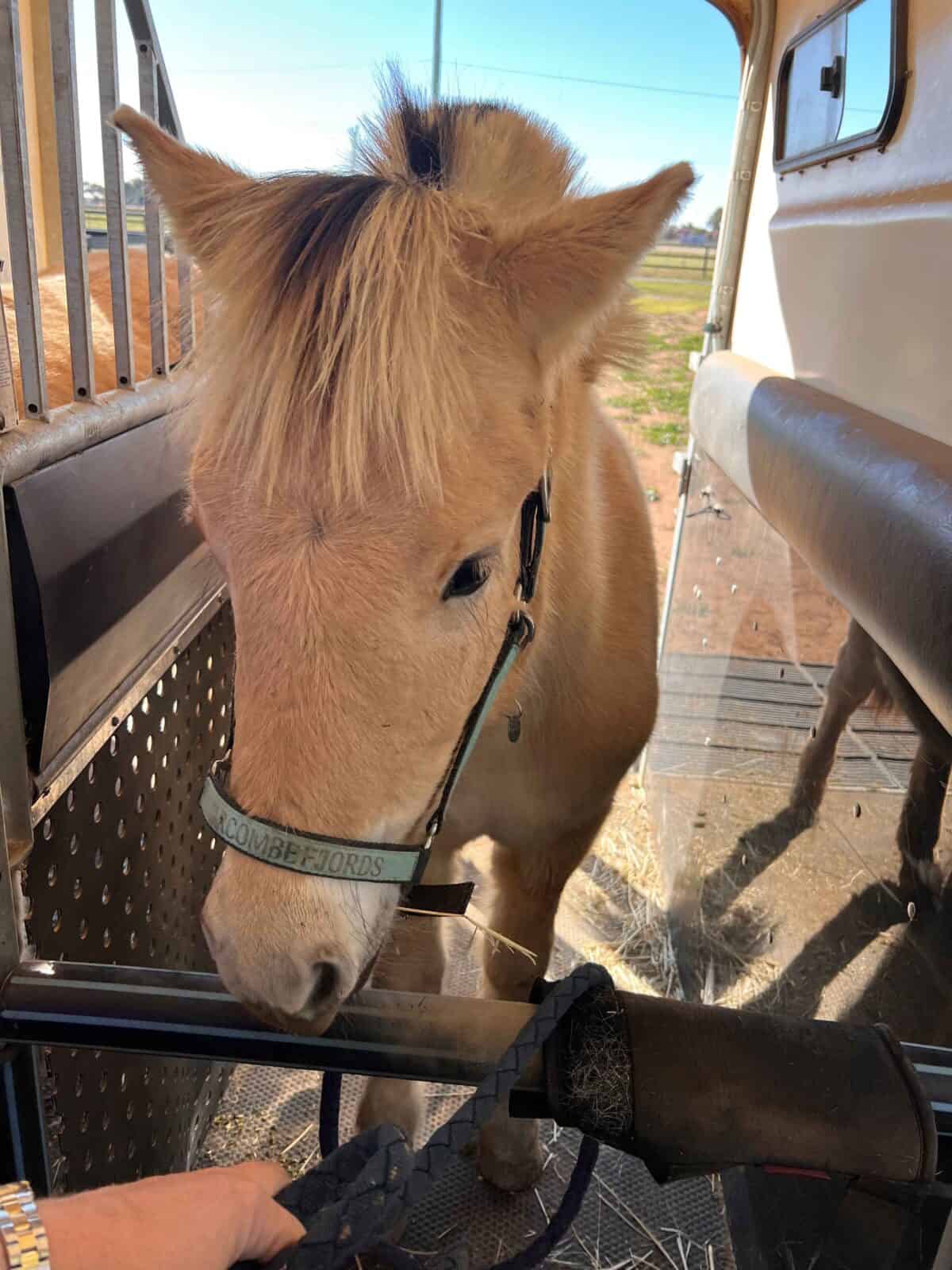
While you were sitting down, your horse was walking the whole way to the venue.
Does the cost stop when the horse steps off the ramp?
No. Transporting horses isn’t just a journey where all that work and its effects stop the moment they’re off the float. The physiological markers of effort and stress stay elevated after unloading, and they take time to return to baseline9.
For the kind of distances most of us actually travel, does this matter? A study comparing a one-hour (50 km) journey with a three-hour (200 km) one in Standardbreds found that the shorter trip produced the higher cortisol response, with cortisol peaking at the end of the one-hour journey. The horses’ measures had returned to normal by about four hours after the trip, and the researchers suggested arriving roughly four hours before competing5. Separate work tracking cortisol alongside heart rate variability found stress markers still raised from five minutes up to three hours after unloading on the outbound leg of a journey4.
Cortisol is one marker of the physiological stress response, but it should not be read as a direct measure of a horse’s moment-to-moment emotional state. After transport, elevated physiological stress markers, fatigue and unfamiliar surroundings can all affect behaviour and readiness to work, so the horse’s individual state should guide what happens next. A wound-up horse is quicker to spook or tense up and slower to focus and learn, so asking for schooling or a competition round in that window means working with a brain that isn’t quite ready. It is easy to read that edginess as the horse being fresh or silly, when really they are still coming down from the journey. The horse that steps off the float is not yet the horse they were before they loaded.
For long hauls the recovery period is longer again, and the immune system is among the systems affected. In a study of horses transported for twenty-four hours, the white-cell count and the neutrophil-to-lymphocyte ratio, a marker of immune stress, both climbed with the hours of travel. These settled during the recovery period, but the horses still carried a body-weight deficit a full day after unloading6. That is part of why horses can be more prone to illness, such as the transport-associated respiratory disease known as shipping fever, in the days following a long journey15.
On top of tired muscles and a raised stress response, there is a third, quieter effect: travel changes how the body fuels its work. Research on exercise after transport has found that a journey shifts the way the horse handles glucose and burns fat during the work that follows, compared with a horse that has not just travelled10. So it is not only the muscles and the nervous system that arrive altered by the trip, but the metabolism that powers the work as well.
None of this means a short local journey is harmful. What the evidence does support is a simple, low-cost piece of management: build in a settling period between unloading and riding. Letting a horse stand, stretch, lower their head, have a drink and simply be still for a while is not pampering. It allows the postural muscles to recover and gives the stress response time to come down before you add the demands of being ridden. So build in a settling period after unloading and adjust it to journey length, weather, the individual horse and the demands of the event. One Standardbred study suggested allowing around four hours after the journeys it tested, but that should not be treated as a universal recovery rule for every horse or trip.
What should you put in front of them: feeding and watering on the float
Three questions come up again and again: whether to offer hay on the float, whether to feed before or after the trip, and whether feeding on the float risks choke. And have you ever stopped to consider your horse’s hydration level after a float trip?
Provide hay on the float? Yes. A horse produces stomach acid continuously, so a journey without forage lets that acid build up. Added to the balancing effort and confinement we’ve already covered, that is exactly the combination the research links to gastric ulcers after travel3. Providing hay in a net during the journey helps in two ways. Chewing produces saliva, which is the horse’s natural acid buffer, while a steady intake of fibre forms a mat over the stomach contents that limits acid from splashing up onto the unprotected upper part of the stomach11, 16. That splashing is exactly what the movement and jolting of travel tends to stir up. Lucerne hay is especially useful here because its calcium and protein content give it good buffering capacity. For a horse not used to lucerne, their regular hay does the same job. The benefit comes from forage being present and chewed, not from any one type.
The choke fear is mostly misplaced. Many owners avoid feeding on the float for fear of choke, but transport itself is not one of the recognised risk factors. The established drivers of oesophageal obstruction are bolting feed, poor dentition, dry pelleted feeds and unsoaked products such as cubes or beet pulp, foreign material, sedation, and dehydration or exhaustion8. A fit, well-hydrated horse with sound teeth, eating familiar hay at a normal rate, is at low risk wherever they happen to be standing, paddock or float. The one real caveat is the net itself rather than the hay, since horses have been known to swallow pieces of netting. So choose a safe net, and hang it low rather than high. A net strung up near the roof makes the horse eat with their head raised, when on a journey a lowered head is what we actually want, because it lets the airways drain and clear12, 13.
And that leads me to mention water. Feed and water intake are linked, so withholding forage can actually reduce how much a horse drinks. The landmark study here found that horses transported for thirty hours in hot conditions reached more than ten percent dehydration, and that journeys beyond twenty-four hours caused marked dehydration7. Dehydration also feeds into the problem owners worry about most, because transport reduces gut motility: a recent study tracking horses through commercial journeys found intestinal motility dropped after travel, most of all in hot conditions and in the more stressed horses, which is exactly the setup for an impaction colic14. Even a short outing can leave a horse a long time between drinks. Hydrate well before leaving, offer water on arrival and at any stops even if it is refused at first, and travel in the cooler part of the day. On longer or hotter journeys, plan hydration in advance, offer water at appropriate stops and on arrival, and consider whether soaked forage or electrolyte supplementation is appropriate for that individual horse. Electrolyte use should match diet, sweat losses, journey conditions and access to water rather than being a routine pre-travel prescription.
The horse that steps off the float is not yet the horse they were before they loaded.
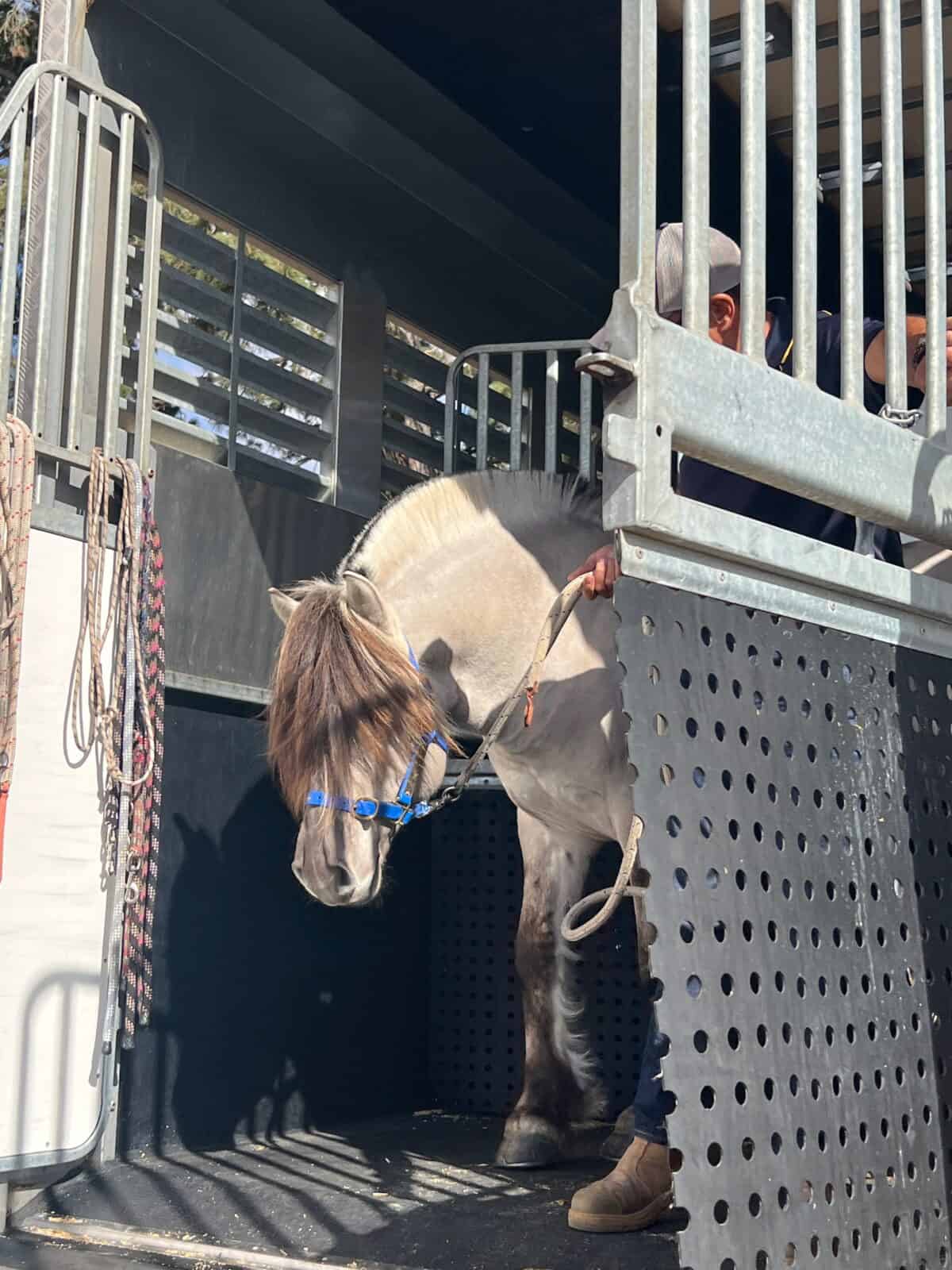
How do you put this into practice?
Travel is something our horses do for us. They don’t choose it, and they can’t prepare for it the way we would before a hard effort, because they have no idea it is coming. So the habits that make it easier on them are ours to put in place, and a few small ones can make the journey far more pleasant, and much less physically demanding, for the horse.
- Give your horse a settling period after unloading before you ride, even a short one, and arrive early when the event matters and the logistics allow.
- Provide adequate space within safe transport limits. Some studies have found fewer balance-related behaviours with wider bays and rear-facing travel, so those factors are reasonable to consider when choosing a new float.
- Where safe and appropriate, provide familiar forage during travel in a securely positioned net or feeder that minimises entanglement risk and does not unnecessarily restrict the horse’s ability to lower its head.
- Match your attention to hydration to the distance and the heat, and remember the whole outing counts, not just the drive.
- Read your horse on arrival as one that has just finished a job, not one that is fresh and ready to go.
None of it costs much. Maybe a little of our sleep on the odd morning, getting up that bit earlier. Maybe thirty to forty dollars for a good hay net. Together, these habits acknowledge a simple truth that is easy to forget from the comfort of the driver’s seat: while you were sitting down, your horse was walking the whole way to the venue, figuratively speaking.
Read your horse on arrival as one that has just finished a job, not one that is fresh and ready to go.
References
- Doherty, O., Booth, M., Waran, N., Salthouse, C., & Cuddeford, D. (1997). Study of the heart rate and energy expenditure of ponies during transport. Veterinary Record, 141(23), 589–592. https://doi.org/10.1136/vr.141.23.589
- Giovagnoli, G., Trabalza Marinucci, M., Bolla, A., & Borghese, A. (2002). Transport stress in horses: an electromyographic study on balance preservation. Livestock Production Science, 73(2–3), 247–254. https://doi.org/10.1016/S0301-6226(01)00253-6
- Padalino, B., & Raidal, S.L. (2020). Effects of transport conditions on behavioural and physiological responses of horses. Animals, 10(1), 160. https://doi.org/10.3390/ani10010160
- Schmidt, A., Möstl, E., Wehnert, C., Aurich, J., Müller, J., & Aurich, C. (2010). Cortisol release and heart rate variability in horses during road transport. Hormones and Behavior, 57(2), 209–215. https://doi.org/10.1016/j.yhbeh.2009.11.003
- Tateo, A., Padalino, B., Boccaccio, M., Maggiolino, A., & Centoducati, P. (2012). Transport stress in horses: effects of two different distances. Journal of Veterinary Behavior, 7(1), 33–42. https://doi.org/10.1016/j.jveb.2011.04.007
- Stull, C.L., & Rodiek, A.V. (2000). Physiological responses of horses to 24 hours of transportation using a commercial van during summer conditions. Journal of Animal Science, 78(6), 1458–1466. https://doi.org/10.2527/2000.7861458x
- Friend, T.H. (2000). Dehydration, stress, and water consumption of horses during long-distance commercial transport. Journal of Animal Science, 78(10), 2568–2580. https://doi.org/10.2527/2000.78102568x
- Chiavaccini, L., & Hassel, D.M. (2010). Clinical features and prognostic variables in 109 horses with esophageal obstruction (1992–2009). Journal of Veterinary Internal Medicine, 24(5), 1147–1152. https://doi.org/10.1111/j.1939-1676.2010.0573.x
- Padalino, B. (2015). Effects of the different transport phases on equine health status, behavior, and welfare: a review. Journal of Veterinary Behavior, 10(3), 272–282. https://doi.org/10.1016/j.jveb.2015.02.002
- Connysson, M., Muhonen, S., & Jansson, A. (2017). Road transport and diet affect metabolic response to exercise in horses. Journal of Animal Science, 95(11), 4869–4879. https://doi.org/10.2527/jas2017.1670
- Sykes, B.W., Hewetson, M., Hepburn, R.J., Luthersson, N., & Tamzali, Y. (2015). European College of Equine Internal Medicine consensus statement: equine gastric ulcer syndrome in adult horses. Journal of Veterinary Internal Medicine, 29(5), 1288–1299. https://doi.org/10.1111/jvim.13578
- Raidal, S.L., Love, D.N., & Bailey, G.D. (1996). Effects of posture and accumulated airway secretions on tracheal mucociliary transport in the horse. Australian Veterinary Journal, 73(2), 45–49. https://doi.org/10.1111/j.1751-0813.1996.tb09963.x
- Takahashi, Y., Niwa, H., Ebisuda, Y., Mukai, K., Yoshida, T., Raidal, S., Padalino, B., & Ohmura, H. (2024). Increased freedom of head movement mitigates stress and bacterial load in the airways of horses during transport. Frontiers in Veterinary Science, 11, 1477653. https://doi.org/10.3389/fvets.2024.1477653
- Raidal, S.L., Freccero, F., Carstens, A., Weaver, S., & Padalino, B. (2025). Road transportation is associated with decreased intestinal motility in horses. Frontiers in Veterinary Science, 12, 1647236. https://doi.org/10.3389/fvets.2025.1647236
- Maeda, Y., & Oikawa, M. (2019). Patterns of rectal temperature and shipping fever incidence in horses transported over long distances. Frontiers in Veterinary Science, 6, 27. https://doi.org/10.3389/fvets.2019.00027
- Vokes, J., Lovett, A., & Sykes, B. (2023). Equine gastric ulcer syndrome: an update on current knowledge. Animals, 13(7), 1261. https://doi.org/10.3390/ani13071261
- Takahashi Y, Niwa H, Ebisuda Y, Mukai K, Yoshida T, Raidal S, Padalino B and Ohmura H (2024) Increased freedom of head movement mitigates stress and bacterial load in the airways of horses during transport. Front. Vet. Sci. 11:1477653. doi: 10.3389/fvets.2024.1477653
Every due care has been taken to ensure the information herein is based on sources Veterinary Nurse Solutions believes to be reliable, but is not guaranteed by us and does not purport to be complete or error-free. As such, we do not warrant, endorse or guarantee the completeness, accuracy, and integrity of the information. You must evaluate, and bear all risks associated with, the use of any information provided hereunder, including any reliance on the accuracy, completeness, safety or usefulness of such information. As part of our quality control of information contained within this document, it has been peer-reviewed by qualified animal care professionals.
Veterinary Nurse Solutions acknowledges that there is more than one way to carry out many of the tasks described within this website, and techniques omitted are not necessarily incorrect.