

WRITTEN BY: HARRIE PHILLIPS
PGCertClinEd, BAdVocEd (VocEd&Trng), DipVN (Surgical, ECC), DipBus, DipTAE (Development & Design), TAA
PUBLISHED: 10 July 2026

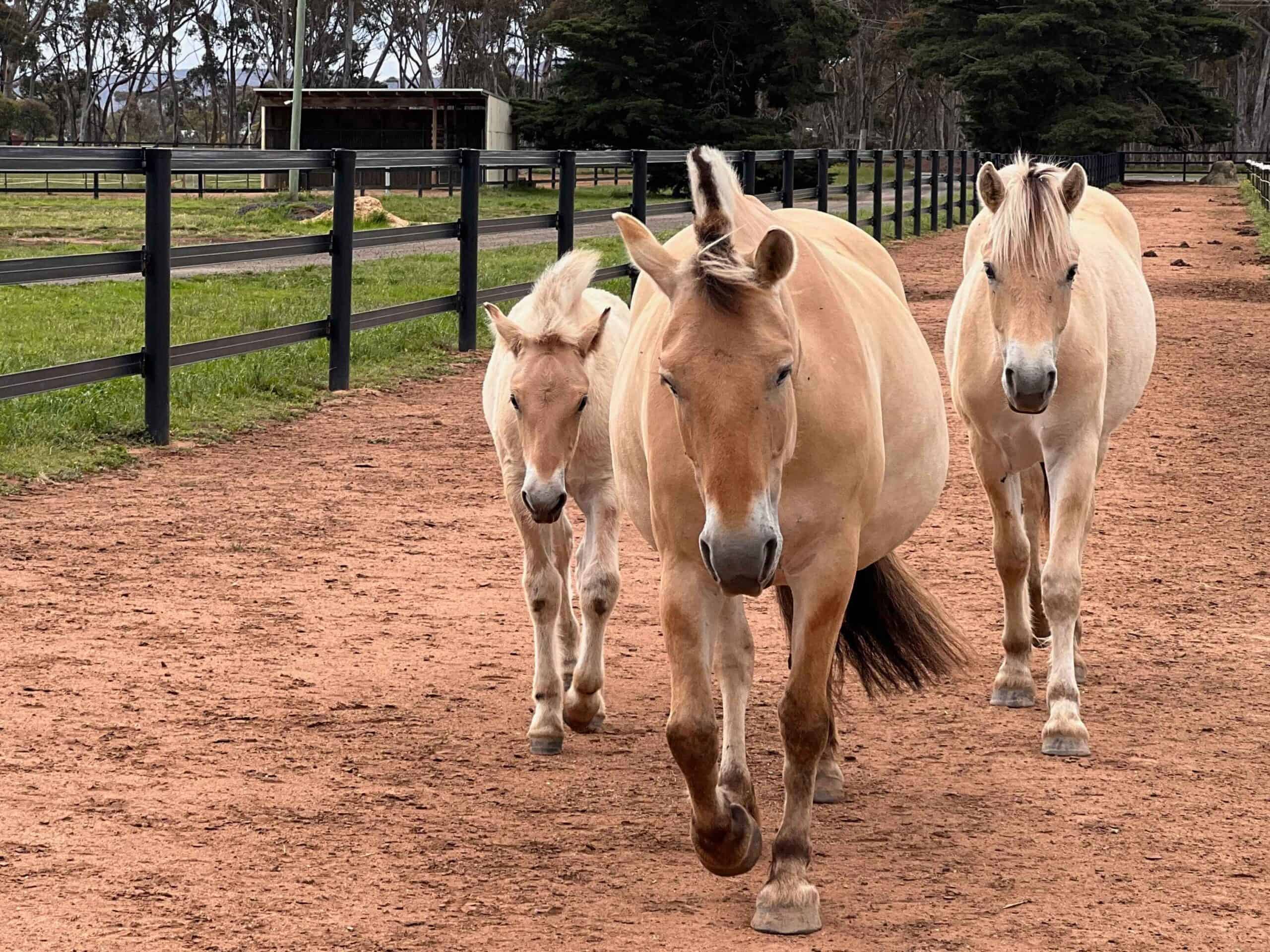
One of my favourite times of the day is morning. I love walking outside with a hot coffee and just watching my herd of Fjord horses do their thing. I run two herds on the property, my ridden herd and the breeding herd. Both are made up of a mix of ages and genders, all paddocked together. The only exception is Obbe my stallion, who is currently paddocked on his own, with Mykle (a gelding) paddocked next door as company. The plan eventually is to get those two in the same paddock together, but for now, this is the safest way for me to manage them whilst doing a slow integration.
My herds are like functional families depicted on idyllic tv shows where family meetings are civil and everyone agrees at the end of the discussion. They share grass without fuss, drift in and out of each other’s space without flaring, just some minor eyeballing, the occasional stink eye even my Grandma Harrison would be proud of. The young ones, who by the traditional horsemanship logic should be hard to manage without firm human leadership, are anything but. Confident, curious, sensible.
There is no alpha mare bossing anyone around out there. I only see horses negotiating space and resources. Nothing in this paddock looks like the strict pecking order the popular horsemanship narrative insists should be the natural state of horse society. The herd is just a herd, getting on with the business of being horses.
This isn’t some amazing horse guru method I am following. What is happening in my paddock is, as far as I can tell, simply what tends to happen when horses are allowed to be horses. Good turnout design, stable group composition, adequate resources and compatible horses make peaceful group living much more likely, although individual horses and groups still differ. I have lost count of the times I have heard that mares and geldings shouldn’t be paddocked together. That horses are better kept in single paddocks to avoid injury. That you have to be the boss when you enter the paddock, especially if it’s a herd paddock. The list goes on.
The dominant frame in horse training, for at least the last few decades, has been built on the idea that horses live in strict hierarchies. At the top of the herd is the alpha mare, who runs the social life of the group and decides where everyone goes. Alongside or just above her is the stallion, the protector, the disciplinarian, the one who keeps order through force when force is needed. Everyone else has a place in the line beneath them, with the youngest, the meekest, and the latest arrivals at the bottom.
This structure is carried over to when a human handles a horse. The human is effectively entering this hierarchy, and to be safely obeyed the human must take the alpha position themselves. The frame is so entrenched in horsemanship culture that it sits underneath training advice, behaviour analysis, even the language we use about our own horses (“she is testing me”, “he needs to know who is boss”). The trouble is that this framework substantially oversimplifies what research shows about equine social organisation and how horses respond to humans, and the research community has been challenging those assumptions for decades.
What frame does the rest of the world use?
If you have spent any time in horse circles, you have absorbed some version of the dominance frame whether you wanted to or not. It is everywhere. It is in the round-pen “join-up” technique, in lots of what gets sold as natural horsemanship, in training language built around respect and leadership and submission and the alpha position. It is the basis of the advice that you must always go through the gateway first, that you must move your horse out of your space when they lean in, not for safety but because allowing the horse that small interaction will erode your authority, that you must continue to push even when the horse has clearly said no and not let them “win”. Many of us were taught to do something like it as our default approach to handling.
The frame has commercial momentum, cultural durability, and the apparent confirmation of seeming to work in the hands of skilled practitioners. What it does not have is empirical support, and the research that has accumulated on horse social behaviour, and on what actually happens during dominance-based training, has been steadily and consistently dismantling almost every part of it.
There is no alpha mare bossing anyone around out there. I only see horses negotiating space and resources.
What do horses actually do socially?
Free-ranging horses have been observed in proper detail for decades now, across multiple populations and continents. What we have learnt from that work looks almost nothing like the popular dominance model.
Horses do form social bonds, and those bonds are the central thing in their social lives, not the secondary thing. Stable groups develop long-term affiliative relationships, with preferred partners, mutual grooming, synchronised resting, and active maintenance of friendships over time1, 2. A 2023 systematic review of equine social behaviour across twenty-seven studies and 851 horses confirmed that affiliative bonds are the well-established foundation of stable group life2, and pointedly noted that researchers themselves have historically been guilty of focusing on aggressive interactions when the friendlier behaviours are actually much more common.
Aggression in stable horse groups is rare. Not absent, but genuinely rare. The most-cited estimate comes from a 2003 study of a free-roaming herd in Iceland that recorded an average of just 0.17 aggressive interactions per horse per hour3, and the 2023 systematic review confirmed this finding holds across the broader literature2. The herd that is constantly enforcing hierarchy through threat displays and biting is mostly a creature of human imagination. Where it does turn up in reality is in two specific contexts, and neither of them is a settled herd at pasture. It turns up in herds with unstable composition where horses are constantly being added and removed, and in herds with constrained resources where the costs of conflict are unusually high. Stable, well-resourced herds spend most of their time grazing peacefully and being mates.
Horses can form stable dominance relationships and, in some groups, measurable dominance hierarchies. These relationships mainly predict priority access to limited resources and the likely outcome of contests. They do not mean that one horse continuously directs the behaviour of every other horse, nor do they justify treating the herd as a simple, rigid ladder with an “alpha” controlling all group activity. Affiliative relationships, social tolerance and preferred partnerships are also central features of stable horse groups. The horse who has priority at the feed bin may not be the one who leads everyone over to the water trough.Leadership of group movement can be distributed and context-dependent. Different individuals may initiate or influence movement, and some studies have found that higher-ranking horses are followed more often. This is very different from the popular idea of one fixed “alpha mare” directing all herd activity4. The idea that there is a single alpha mare running the whole show is, in the words of the actual research, an oversimplification that detailed observation of free-ranging horses does not support4, 5.
Where did the wolf-pack story come from?
If horse herds don’t work the way the dominance frame insists they do, where did the frame come from in the first place? The answer takes us on a brief detour through wolves, because the alpha mare in horsemanship is, more or less, an alpha wolf dressed up in horse clothing.
The “alpha wolf” concept came from a small body of research conducted in the mid-twentieth century on captive wolf packs. The most influential of these was Rudolph Schenkel’s 1947 study, which observed unrelated wolves placed together in captivity and described the resulting power struggles as a model of normal wolf life. The work was widely cited, and the alpha framework entered both academic and popular literature as the dominant model of wolf behaviour for decades.
The trouble is that captive wolves placed together as adults are not normal wolves. Wild wolf packs are family groups, made up of a breeding pair and their offspring from the previous one to three years. The constant jockeying for position, the dominance displays, the violent contests for rank, are dynamics produced by forcing unrelated adult animals to live together in a confined space. They are not what wild wolves do.
This was finally and decisively set out by L. David Mech in 1999, in a paper published in the Canadian Journal of Zoology with the splendidly direct title “Alpha Status, Dominance, and Division of Labor in Wolf Packs”6. Mech had spent thirteen summers observing a wild wolf pack on Ellesmere Island in Northwest Canada, close enough at times to be within a metre of them, and across all those years and all those observations he did not see a single dominance contest. What he saw was a family. Parents and offspring, with the kind of leadership a parent provides to a child rather than the kind an alpha asserts over a subordinate. Mech has since spent most of the years between then and now trying to retract his own earlier 1970 book, the one that had popularised the alpha concept in the first place, and asking publishers to stop reprinting it. The alpha terminology is no longer used in serious wolf research. The family-group model is the standard.
Popular horsemanship ideas about “alpha” animals developed alongside the wider twentieth-century popularity of dominance and alpha terminology. Whatever their historical pathway into horse training, applying a simple alpha-leader model to horses is not supported by contemporary evidence on equine social behaviour.
The model we built our horsemanship on was a model built about wolves. The wolves it was built on weren’t even wild.
Why does the leader frame fail for horses?
Even if horse herds did operate on a strict alpha-led hierarchy, which they don’t, there is a separate question worth asking. Do horses include humans in their social structure at all? Because for the leader-of-the-herd model to work, they would have to.
There is no good evidence that horses incorporate humans into their horse-to-horse dominance hierarchy, or that a human must achieve high social status in that hierarchy to obtain safe, reliable responses. Research is better able to explain human-horse training outcomes through learning history, reinforcement and the predictability of human behaviour7, 5. Horses can certainly learn that a particular human is a source of food, of release from pressure, of safety, of discomfort, of unpredictable behaviour, or of some combination of these (most of us are a combination, if we are honest). What they cannot do, or at least what they have not been shown to do, is treat humans as fellow horses competing for position in the herd.
This is why the round-pen “join-up” technique, which is one of the most visible practical expressions of the leader frame, has not held up to scientific scrutiny. The technique works by chasing the horse in a confined circle until they show certain behaviours that the practitioner interprets as submission and acceptance of leadership, at which point the horse is allowed to approach and “join up” with the trainer. When researchers actually tested the round-pen technique, the picture got even worse for the leader-frame interpretation. Twenty-six horses tested in this technique followed the trainer faster over successive trials regardless of who was doing the chasing and regardless of how the chasing was being done8. The horse was not learning that this particular human had earned alpha status. The horse was learning, very simply, that once the chasing stopped, approaching the human was what made the unpleasantness stop too. The following response can be explained through learning processes: approaching or following the trainer can become more likely when it predicts the end of chasing or pressure. That does not demonstrate that the horse has recognised the human as a social leader9. The mechanism is operant conditioning, the same mechanism that runs underneath every interaction we have with our horses. The alpha interpretation is something humans bring to it.
The leadership concept as advocated in so many training manuals and methods has been shown to be unreliable in the horse, and the horse’s response to training is far better explained by reinforcement than by any human attaining high social status5.
Recent corroborating work has reinforced and extended this finding10, 11.
What is the welfare connection?
The dominance myth isn’t just about training methods. It has welfare consequences for the horses being handled using it.
The methods that flow from the leader frame tend, in practice, to rely on assertive corrections, escalating pressure, and the deliberate production of submission-like behaviours in the horse. Which means horses trained within dominance-based systems experience higher levels of aversive stimulation than horses trained within evidence-based equitation science. Training approaches that rely heavily on escalating aversive stimulation, conflict or the deliberate elicitation of flight and submission-like responses raise welfare and safety concerns. This is one reason ISES recommends training that minimises fear, confusion and excessive arousal rather than attempting to establish social dominance over the horse11.
This is not a theoretical concern. The ten First Principles of Horse Training laid out by the International Society for Equitation Science explicitly include keeping horses in a low state of arousal during training and avoiding the elicitation of flight responses. Dominance-based training, almost by design, contradicts these principles, and the ISES has formally cautioned against the use of leadership and dominance concepts in training in its position statement on the topic, warning that they “could jeopardize a harmonious relationship with the horse and compromise his welfare”12.
The hard truth, for anyone who has invested significant time and money in dominance-based methods, is that the methods can produce horses who appear compliant in the short term while leaving long-term welfare and behavioural consequences that surface later.
A horse that follows a trainer after round-pen chasing has not, by that behaviour alone, demonstrated trust or acceptance of human leadership. The response can be explained through reinforcement contingencies, including learning that approaching or following is associated with the cessation of chasing or pressure.
What does this mean in practice?
If the leader frame is unsupported and the methods built on it are welfare-negative, what should you do instead?
Give the horse clear, consistent cues. Get your timing right. Apply pressure that is meaningful and release it on the response you want. Reinforce the behaviours you want to see, not those you don’t. Avoid the chronic stress and confusion that come from inconsistent handling. Remember that every interaction is a training event, and that the horse is forming associations from the very first moment of any encounter onwards, every time. Work with the horse’s nervous system rather than against it, recognise when arousal has crossed the threshold where meaningful learning becomes too hard, and have the patience to reset rather than push through. None of this requires you to be the leader of anything. It requires you to be a clear, consistent, reasonable handler. Which turns out to be a substantially easier position to hold than the alpha position.
Your horse is not looking for a leader. The horse is looking for an environment that is predictable, a handler whose signals they can read, and a degree of agency over their own responses. Provide those things and the horse will, in most cases, give you the cooperation you are seeking, without the assertion that the dominance frame requires. Provide them consistently over months and years, and you will end up with the kind of working relationship that good horsemanship has always produced, just without the unnecessary ideological scaffolding.

Back at the paddock
The herd outside my window is doing what horses do.
Obbe and Mykle, paddocked next door to each other, are grooming through the fence with their teeth working along their withers in slow synchronised passes.
In the main herd, two of the older mares are doing what they always do, nose-to-tail at the far end of the paddock, swishing each other’s flies.
One of the yearlings is following one of the older geldings around at a respectful distance, copying his pace, stopping when he stops, inviting a little play.
A foal has wandered off to investigate a fallen branch and is making their own decisions about whether it is interesting or alarming. Nobody is helping. Nobody needs to.
Nothing I am watching requires a single fixed leader to explain it. These horses are maintaining social relationships, responding to one another, negotiating access to resources and making individual decisions within a stable group. What they are doing is what stable, settled, well-resourced horses tend to do. Living alongside each other with patience, affection, the occasional disagreement settled quickly, and a calm willingness to engage with the people who look after them. The science of why this works has been quietly accumulating for years. The dominance frame has not held up. The horses, who never read the manual in the first place, were getting on with it anyway.
References
- van Dierendonck, M.C. (2006). The Importance of Social Relationships in Horses. PhD thesis, Utrecht University.
- Torres Borda, L., Auer, U., & Jenner, F. (2023). Equine social behaviour: love, war and tolerance. Animals, 13(9), 1473. https://doi.org/10.3390/ani13091473
- Sigurjónsdóttir, H., van Dierendonck, M.C., Snorrason, S., & Thórhallsdóttir, A.G. (2003). Social relationships in a group of horses without a mature stallion. Behaviour, 140(6), 783–804. https://doi.org/10.1163/156853903322370670
- Górecka-Bruzda, A., Jaworska, J., & Stanley, C.R. (2023). The social and reproductive challenges faced by free-roaming horse (Equus caballus) stallions. Animals, 13(7), 1151. https://doi.org/10.3390/ani13071151
- Hartmann, E., Christensen, J.W., & McGreevy, P.D. (2017). Dominance and leadership: useful concepts in human-horse interactions? Journal of Equine Veterinary Science, 52, 1–9. https://doi.org/10.1016/j.jevs.2017.01.015
- Mech, L.D. (1999). Alpha status, dominance, and division of labor in wolf packs. Canadian Journal of Zoology, 77(8), 1196–1203. https://doi.org/10.1139/z99-099
- McGreevy, P.D., Oddie, C., Burton, F.L., & McLean, A.N. (2009). The horse-human dyad: can we align horse training and handling activities with the equid social ethogram? The Veterinary Journal, 181(1), 12–18. https://doi.org/10.1016/j.tvjl.2009.03.005
- Krueger, K. (2007). Behaviour of horses in the “round pen technique”. Applied Animal Behaviour Science, 104(1–2), 162–170. https://doi.org/10.1016/j.applanim.2006.04.031
- Henshall, C., & McGreevy, P.D. (2014). The role of ethology in round pen horse training: a review. Applied Animal Behaviour Science, 155, 1–11. https://doi.org/10.1016/j.applanim.2014.03.004
- Campbell, A. (2023). The ethics of using dominance-based training within the equine leisure industry: Part 1. IAABC Foundation Journal, 28. Available online
- Campbell, A. (2025). The ethics of using dominance-based training within the equine leisure industry: Part 3. IAABC Foundation Journal, 30.
- International Society for Equitation Science (2017). Position statement on the use/misuse of leadership and dominance concepts in horse training. Available at: www.equitationscience.com
Every due care has been taken to ensure the information herein is based on sources Veterinary Nurse Solutions believes to be reliable, but is not guaranteed by us and does not purport to be complete or error-free. As such, we do not warrant, endorse or guarantee the completeness, accuracy, and integrity of the information. You must evaluate, and bear all risks associated with, the use of any information provided hereunder, including any reliance on the accuracy, completeness, safety or usefulness of such information. As part of our quality control of information contained within this document, it has been peer-reviewed by qualified animal care professionals.
Veterinary Nurse Solutions acknowledges that there is more than one way to carry out many of the tasks described within this website, and techniques omitted are not necessarily incorrect.