

WRITTEN BY: HARRIE PHILLIPS
PGCertClinEd, BAdVocEd (VocEd&Trng), DipVN (Surgical, ECC), DipBus, DipTAE (Development & Design), TAA
PUBLISHED: 15 May 2026

A few years ago, when I was still relatively new to owning horses, I purchased an 18-year-old dressage schoolmaster mare named Rory, a kind and generous horse with a long and unblemished record of being reliable in just about every situation she had encountered, including, among many other settled habits, the simple matter of being loaded onto a float. Within months of being in my care, she would not load at all. This is a piece about equitation science, the evidence-based study of how horses actually learn, and how I managed to undo her perfect float training without even trying…
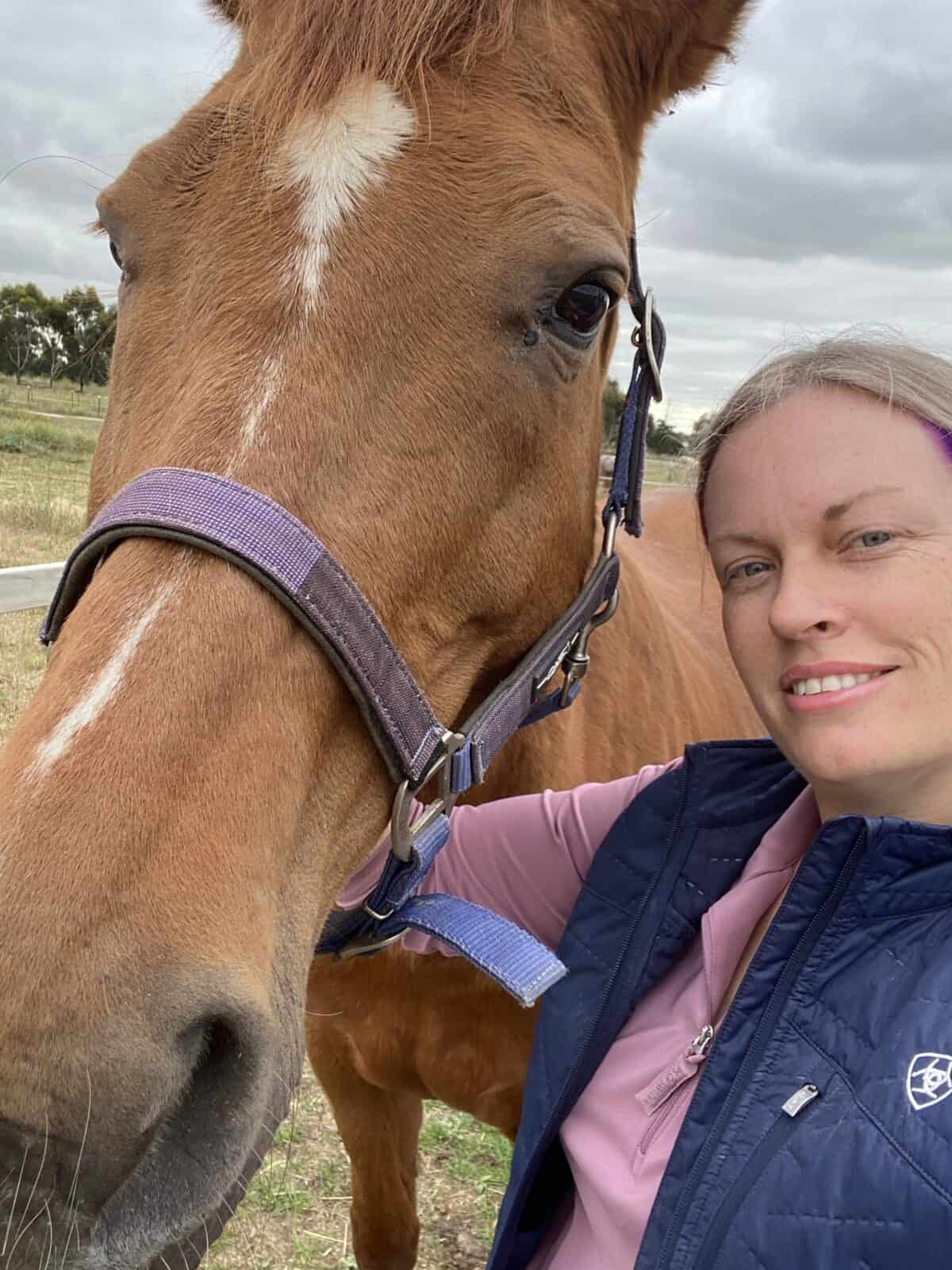
The timing of her arrival did not help. I bought her during the COVID lockdowns, which meant that for the first stretch of our partnership we had no real cause or opportunity to float anywhere, and so the question of whether she still loaded easily simply did not come up until restrictions lifted and I went to float her for the first time. When that day arrived, the wheels came well and truly off. She would not approach the ramp willingly, and when I persisted she would swing sideways, plant herself, or back up entirely, turning what should have been a short and uneventful task into sessions that stretched into hours. I started to avoid going anywhere, if I did need to go, gave myself extra time to load and just accepted that this was her. Help from experienced horse people along the way, kindly offered, only made the situation progressively worse, and eventually I had a horse who actively dreaded the float and a problem I had no idea how to solve.
What I worked out, eventually, was that my own cue and reinforcement timing had become part of the problem. Rory had not simply “become difficult”; our loading history and my handling had changed the contingencies around the float. My pressure-release timing was inconsistent, my cues were not landing where I thought they were landing, and over the course of our quiet lockdown partnership those once-reliable responses had been slowly diluted by my own confused signalling. The fix, when I finally found it, involved positive reinforcement, counterconditioning, and a complete reset of how I was applying pressure, and within a few weeks Rory was self-loading.
Rory taught me more about training horses in a few months than several years of riding had before that. More importantly, she pushed me to start reading the equitation science literature properly, and to start thinking carefully about the way horses actually learn, drawing on my previous life experience of training dogs.
Every interaction we have with our horses is training, whether we intend it to be or not. Once you recognise this, you cannot unsee that fact, and you will probably start handling horses very differently.

What is equitation science?
Equitation science applies established principles from learning theory, ethology and behavioural science to the way horses are trained, handled and ridden. As a field it has been around for more than two decades, supported by peer-reviewed research, dedicated journals, and an international society (the International Society for Equitation Science, ISES)1a. Despite this, most everyday horse owners have never heard of it.
The gap between what equitation science research has established and what is taught in everyday horsemanship is wide 1b, 2. Most riders are taught one or two principles of learning theory, typically use pressure-release, and assume that is the whole picture. It isn’t, and the consequences of that gap show up in the behaviour and welfare of horses every day. They showed up plainly in my paddock with Rory, and once you have the framework, you start to see them everywhere.
There is enormous variation in training methods used across the horse world. Some methods work well, some don’t, and some work for the wrong reasons. The point of this article is not to dismantle methods, horsemanship leaders or name brands, but to give you the underlying knowledge to evaluate any method you encounter against what we know about how horses actually learn.
What are the four quadrants of operant conditioning in horse training?
Operant conditioning describes how an animal learns from the consequences of its behaviour3a. There are four quadrants, and most of us only know one of them well but would be using all 4 daily without realising it.
- Negative reinforcement: removing something (such as pressure) to increase a behaviour. The horse moves forward in response to leg pressure, and the leg comes off.
- Positive reinforcement: adding something pleasant to increase a behaviour. The horse stands quietly at the mounting block and receives a wither scratch or food reward.
- Positive punishment: adding something unpleasant to decrease a behaviour. The horse nips and receives a sharp verbal correction.
- Negative punishment: removing something pleasant to decrease a behaviour. The horse becomes pushy at the gate, and the handler walks away.
The terms positive and negative are commonly misunderstood. They do not mean good or bad; they mean addition or subtraction. Reinforcement increases the likelihood of a behaviour occurring again, and punishment decreases it3b.
Negative reinforcement is the dominant learning mechanism used in ridden work. Pressure is applied through the legs, seat, reins, or whip, and removed when the horse offers the correct response. When used with low-intensity cues, clear timing and prompt release, negative reinforcement can be an effective training method. Its welfare impact depends on how aversive the pressure is, how predictable the contingency is, and whether fear, pain or conflict is being produced1c. The word “negative” carries no judgement here, since it describes the subtraction of pressure as the reinforcing event rather than any quality of harshness or cruelty.
Positive reinforcement, particularly food-based, is well established in the literature as effective and welfare-positive4a, and yet it remains under-used in everyday horsemanship, often dismissed as “treat training” or assumed to create pushy horses. When applied with appropriate protocols, food-based positive reinforcement can be effective without producing biting or dangerous food-seeking behaviour. Hand-feeding has, however, been associated with some milder oral investigative behaviours such as licking hands and searching clothing, so delivery technique still matters4b. Positive reinforcement is particularly useful when retraining a horse with negative associations, when working with fearful or shut-down horses, and when teaching a behaviour from scratch where pressure alone would be confusing or stressful for the horse.
This is the part most riders find clarifying. You are not choosing between these quadrants; you are already using all four of them every day. You scratch the wither when the horse stands quietly, you release lead rope pressure when they step back out of your space, you growl when they nip, and you walk away from the gate when they become pushy. The question is not whether you are using these tools, because you are, just maybe you have never named them. The question is – are you are using them with purpose?
How do classical conditioning and habituation affect horse training?
Operant conditioning is not the whole picture. There are two further learning mechanisms worth understanding, both of which are running in the background of every interaction you have with your horse.
Classical conditioning describes the formation of associations between stimuli. The horse learns that the rattle of the feed bin means dinner is coming. The horse learns that the float means a long, uncomfortable journey, or alternatively, that the float means hay and a comfortable arrival somewhere good. These associations form whether we intend them to or not, and they have powerful effects on a horse’s emotional response to everyday events1d.
Habituation is the process by which a horse’s response to a repeated, harmless stimulus decreases over time. The pony who stops flinching at the tractor in the next paddock has habituated, and done well with intent to desensitise, this is the foundation of producing a calm, sensible horse who can cope with the variability of the human world5a.
Done badly, an attempt at habituation can become flooding: prolonged, forced exposure to a stimulus at an intensity the horse cannot readily escape or cope with. Flooding can produce horses who appear calm but remain physiologically stressed, with the potential for sudden and explosive responses later5b. The distinction between habituation and flooding is not always obvious from the outside, and getting it right is one of the most important skills in working with young or fearful horses.
What was actually going wrong with Rory
Rory had a long history of reliable cue responses; she knew what leg pressure meant, what a lead rope cue meant, and what being asked to walk forward looked like, and none of that knowledge was lost when she came to me. What I did, slowly and without realising it, was degrade those responses through inconsistent application of my cues and reinforcers.
This is the part most horse owners are never taught, and it matters: a trained cue is not a permanent installation but a learned response that has to be maintained through consistent reinforcement. Every time you apply a cue and release at the wrong moment, you are not teaching the horse nothing; you are teaching them something, and often what you are teaching them is that the cue no longer means what it used to. Equitation science researchers describe this as the dilution or extinction of trained responses through inconsistent timing6. Releasing pressure a fraction of a second too late teaches them that what they were doing at that moment was correct, so if they were bracing, you have reinforced bracing, and if they were stopping, you have reinforced stopping. Do this enough times, and the original cue stops producing the original response. The horse is not being naughty; they are responding accurately to the new pattern you have unintentionally trained.
Three things determine whether any training method works: clarity of the cue, timing and consistency. With Rory, my cues were not clear, my timing was off, and my reinforcement was inconsistent. All three had quietly slipped, and the original training had quietly slipped with them.
This is one of the most common problems I see, particularly with new horses in a new home. Riders assume that because the previous owner had the horse responding well, the horse is “trained” and will continue to respond regardless of how they are now being handled. The horse may indeed be trained, but training is a moving target, and within weeks of inconsistent handling those responses can be quietly diluted into something quite different. This might be a familiar scenario, new horse owners that within a month or so are complaining that the horse sold to them was “not as advertised”.
A trained cue is not a permanent installation. It is a learned response that has to be maintained through consistent reinforcement.
In Rory’s case, my inconsistent pressure-release at the float diluted her loading response over a series of attempts that I genuinely thought I was handling well. Worse, the repeated unpleasant sessions began to layer a classically conditioned negative association onto the float itself, and each helper who applied more pressure compounded both problems. We were not just dealing with a confused horse; we were dealing with a horse who had been actively retrained, by accident, to do the opposite of what we expected, and who was beginning to find the entire context aversive.
Fixing it
The fix required two changes. First, the negative association with the float needed to be broken down, so I stopped trying to push her on at all and instead broke loading into very small approximations, using positive reinforcement (food and calm relief) to reward any forward movement toward the float. This used both shaping and counterconditioning: the loading task was broken into small achievable steps while the float was paired with more positive outcomes. The float needed to mean something good again before any cue I applied could be expected to work properly.
Second, I had to clean up my own pressure-release. Once Rory was relaxed around the float, I reintroduced familiar cues with deliberate, consistent timing, and paired them with positive reinforcement when she responded correctly. Both positive reinforcement and negative reinforcement can be used in loading programmes, and combining them is common in practice. However, the evidence base specifically comparing well-defined combined reinforcement with other approaches is still limited, so it is safer not to claim that the combination is generally more effective or lower-stress than negative reinforcement alone4c. She loaded reliably within a small number of sessions and was back to self-loading shortly afterwards.
Rory had not changed and the principles of learning theory had not changed; what changed was my own awareness of what was actually happening between us, and my ability to apply the right tool for the situation.
Learning and welfare are linked
Understanding how horses learn is not only a training issue, but also a welfare issue.
High or uncontrollable stress can impair acquisition of the response we are trying to teach and can reduce cognitive flexibility. At the same time, the horse is still learning associations, including fear, avoidance and escape responses, which is one reason highly stressful training can create persistent problems8. A horse who has gone quiet because they are overwhelmed may look, to an untrained eye, like a horse who has accepted the lesson, but they actually have not. They are coping. The behavioural outcome can look identical from the outside, but the internal state, and the long-term consequences, are very different. You have a horse that may become suddenly unpredictable, and that is a safety issue.
A horse who stops resisting might have learned what we intended, but they may also have ‘given up’, and even experienced handlers could mistake one for the other.
Now, some of the well-meaning advice I was also given when Rory and I were struggling, was to be more assertive and show her who the boss is. This might sound familiar. However, research supports both dominance relationships and long-term affiliative relationships in horses. Some groups show stable, measurable dominance hierarchies, but this does not support the separate claim that humans must become “alpha” or reproduce horse-to-horse social rank to train safely. Human-horse responses are better explained through learning history, reinforcement and predictable handling.7a, 9. The “be the boss” framing common in some training traditions is not supported by current research on equine social behaviour, and the persistence of this framing in horsemanship has been raised repeatedly as a welfare concern7b.
How do I start applying equitation science to my own horse?
For now, the most useful thing you can do is start paying close attention to what you are actually reinforcing. Spend a single ride or grooming session watching yourself rather than your horse, noting every release of a cue, every scratch, and every walk-away, and ask yourself whether the horse had just done what you wanted at that moment or whether your timing was a beat off. If a horse that previously performed a behaviour reliably begins doing it less well, first consider pain, health, fatigue, equipment, environment and emotional state. Changes in behaviour can be an early sign of discomfort. Once those possibilities have been considered, examine whether cues, timing or reinforcement have also changed. This is very common between a change of handlers/owners.
If you would like to go deeper, the next articles in this series build directly on these ideas: what happens when a training session starts to slip, and why pushing through rarely works, why float travel is a workout your horse cannot opt out of, and why you do not need to be the leader of your horse.
Every interaction you have with your horse is training them, whether you intend it to be or not. Your horse is always learning. Understanding this is what allows you to be deliberate about what they are learning from you.
References
- McGreevy, P., & McLean, A. (2010). Equitation Science. Wiley-Blackwell. ISBN 978-1-4051-8905-7. View on Google Books
- Randle, H., & Waran, N. (2019). Equitation science in practice: How collaboration, communication and change can improve equine welfare. Journal of Veterinary Behavior, 29, viii–x. https://doi.org/10.1016/j.jveb.2018.12.014
- Skinner, B.F. (1938). The Behavior of Organisms: An Experimental Analysis. Appleton-Century. View at B.F. Skinner Foundation
- Hendriksen, P., Elmgreen, K., & Ladewig, J. (2011). Trailer-loading of horses: Is there a difference between positive and negative reinforcement concerning effectiveness and stress-related signs? Journal of Veterinary Behavior, 6(5), 261–266. https://doi.org/10.1016/j.jveb.2011.02.007
- Christensen, J.W., Rundgren, M., & Olsson, K. (2006). Training methods for horses: habituation to a frightening stimulus. Equine Veterinary Journal, 38(5), 439–443. https://doi.org/10.2746/042516406778400574
- McLean, A.N., & Christensen, J.W. (2017). The application of learning theory in horse training. Applied Animal Behaviour Science, 190, 18–27. https://doi.org/10.1016/j.applanim.2017.02.020
- McGreevy, P. (2012). Equine Behavior: A Guide for Veterinarians and Equine Scientists (2nd ed.). Saunders Elsevier. ISBN 978-0-7020-4337-6. View at Elsevier
- Mendl, M. (1999). Performing under pressure: stress and cognitive function. Applied Animal Behaviour Science, 65(3), 221–244. https://doi.org/10.1016/S0168-1591(99)00088-X
- VanDierendonck, M.C., de Vries, H., Schilder, M.B.H., Colenbrander, B., Þorhallsdóttir, A.G., & Sigurjónsdóttir, H. (2009). Interventions in social behaviour in a herd of mares and geldings. Applied Animal Behaviour Science, 116(1), 67–73. https://doi.org/10.1016/j.applanim.2008.07.003
- International Society for Equitation Science. www.equitationscience.com
- Dyson, S. (2022). The Ridden Horse Pain Ethogram. Equine Veterinary Education, 34. DOI: 10.1111/eve.13468
- Torres Borda, Auer & Jenner (2023), Animals 13, 1473
- Bradshaw-Wiley et al. (2025), Applied Animal Behaviour Science, 291, 106718. DOI: 10.1016/j.applanim.2025.106718.
- Hartmann, Christensen & McGreevy (2017), JEVS 52, 1-9
Every due care has been taken to ensure the information herein is based on sources Veterinary Nurse Solutions believes to be reliable, but is not guaranteed by us and does not purport to be complete or error-free. As such, we do not warrant, endorse or guarantee the completeness, accuracy, and integrity of the information. You must evaluate, and bear all risks associated with, the use of any information provided hereunder, including any reliance on the accuracy, completeness, safety or usefulness of such information. As part of our quality control of information contained within this document, it has been peer-reviewed by qualified animal care professionals.
Veterinary Nurse Solutions acknowledges that there is more than one way to carry out many of the tasks described within this website, and techniques omitted are not necessarily incorrect.